
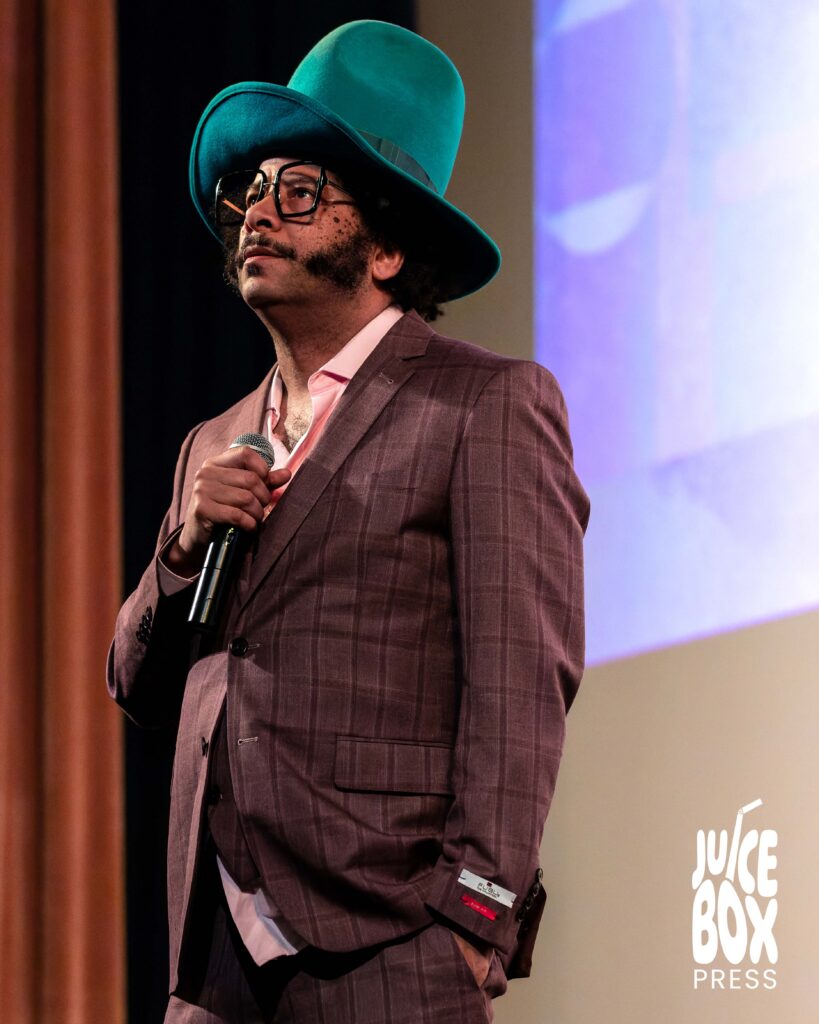
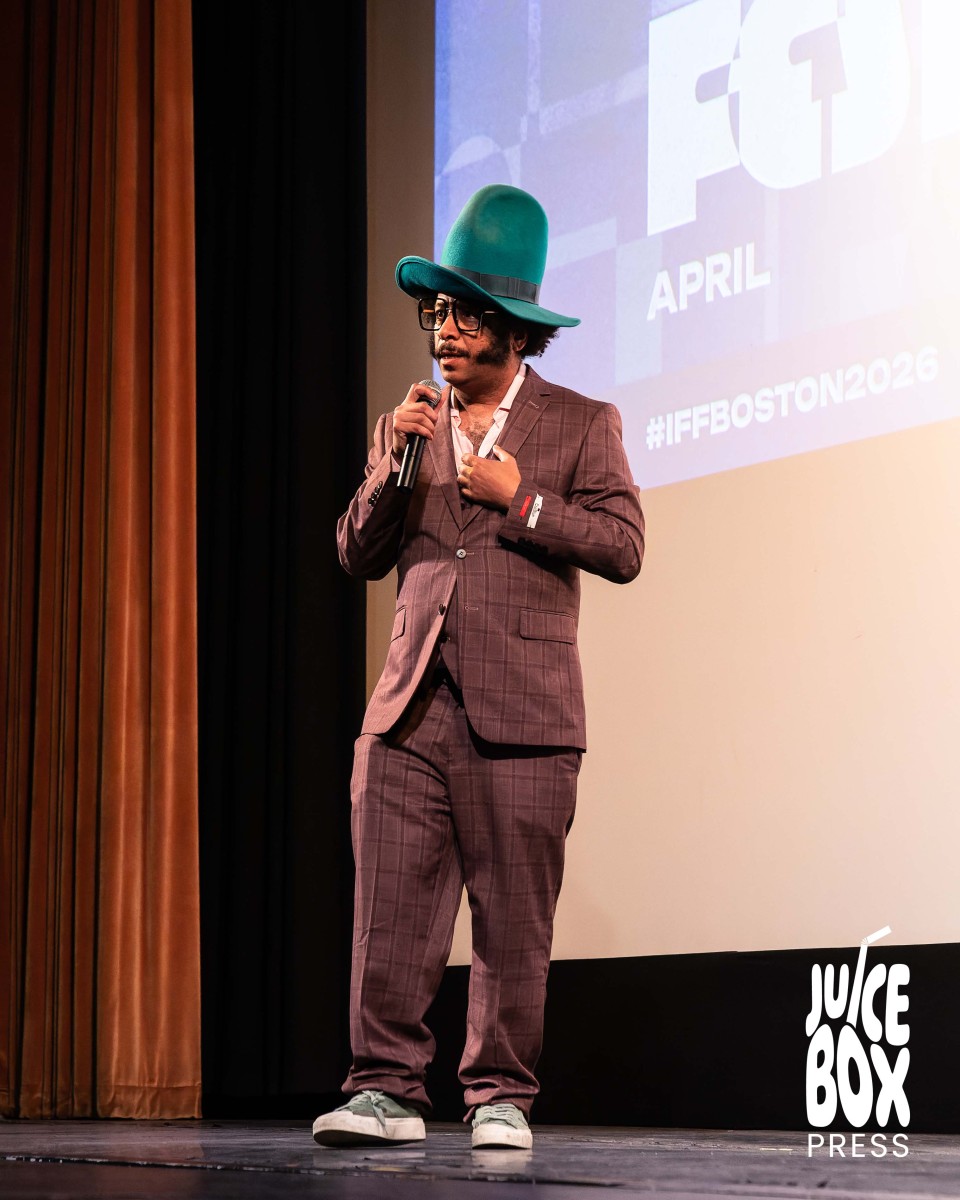
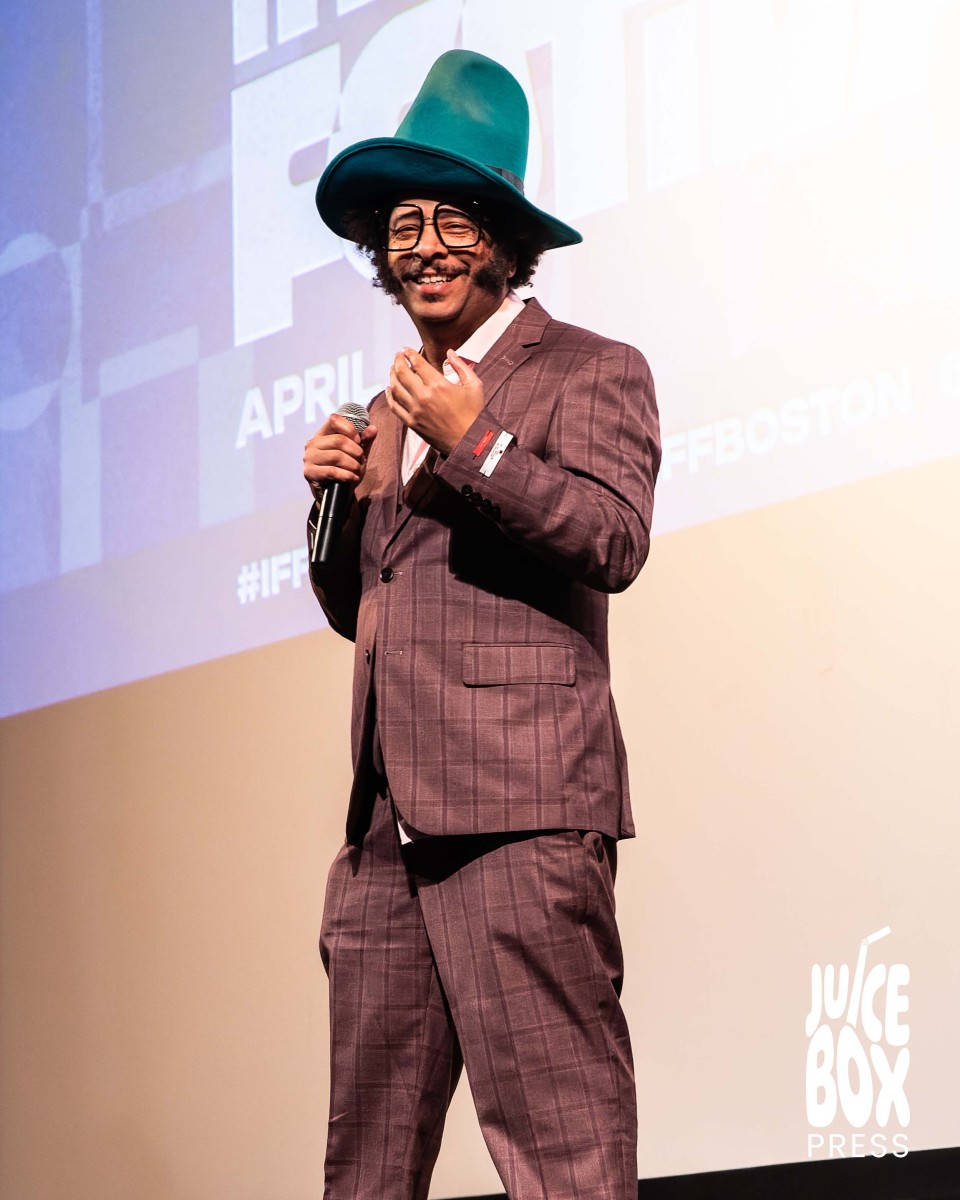
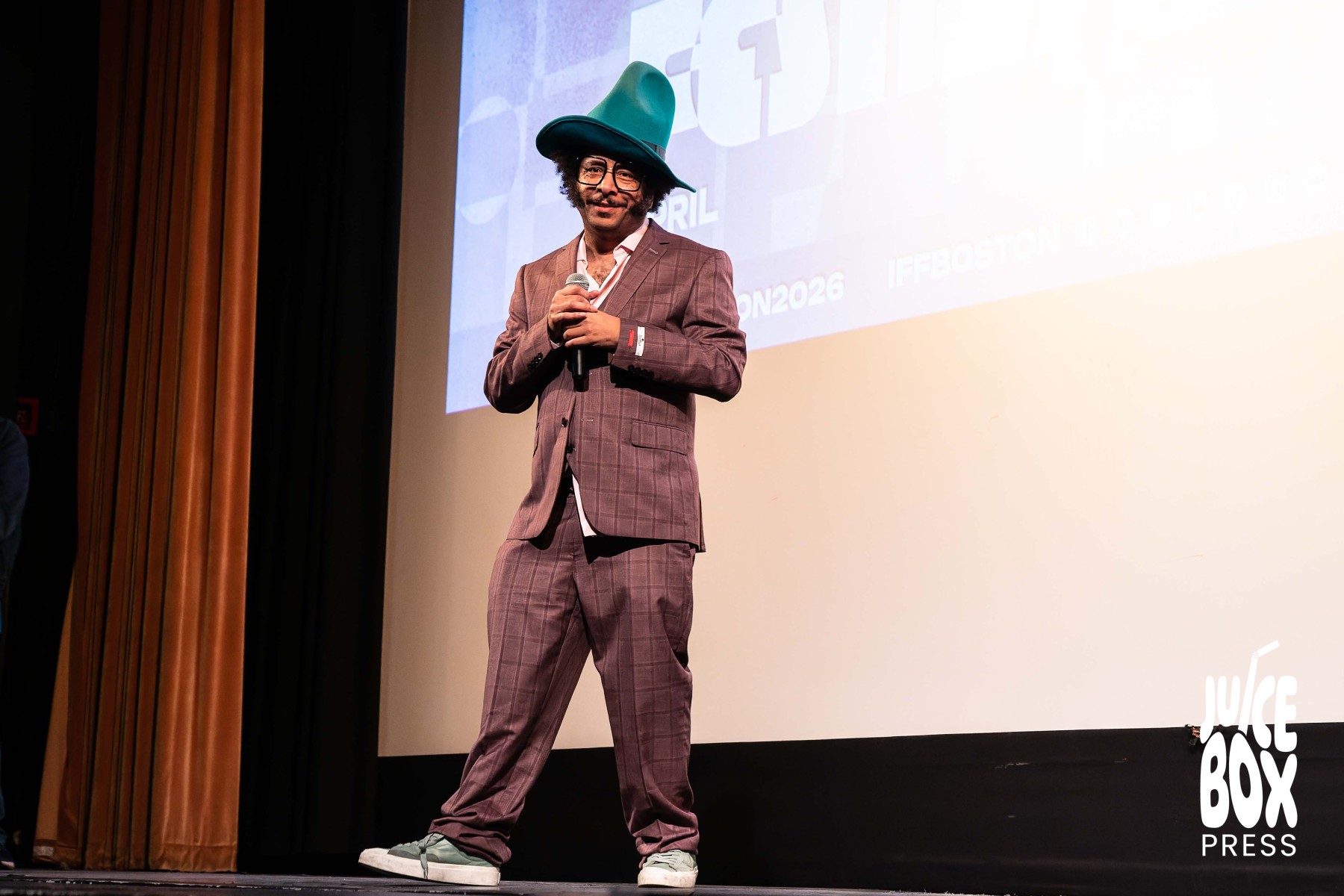
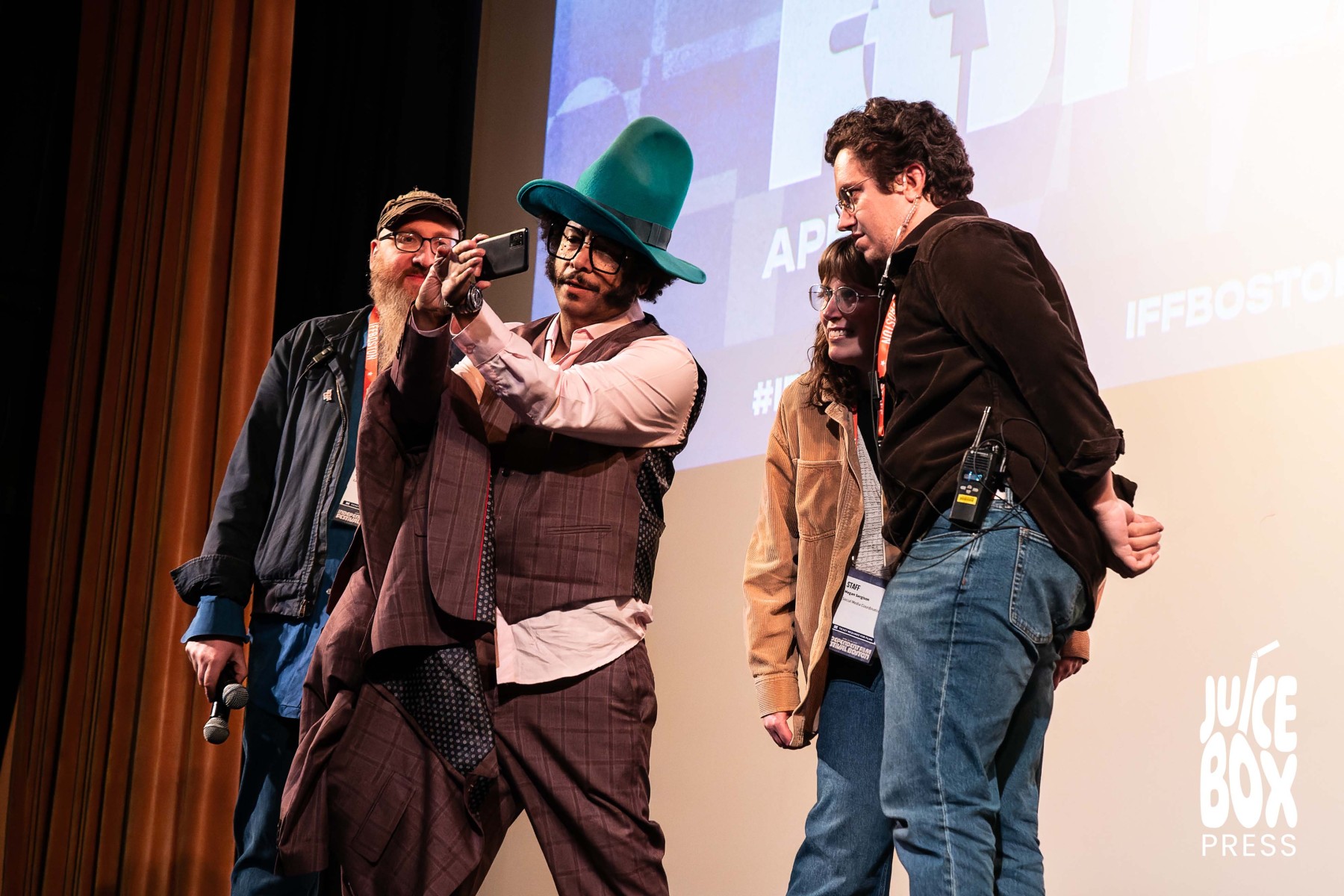
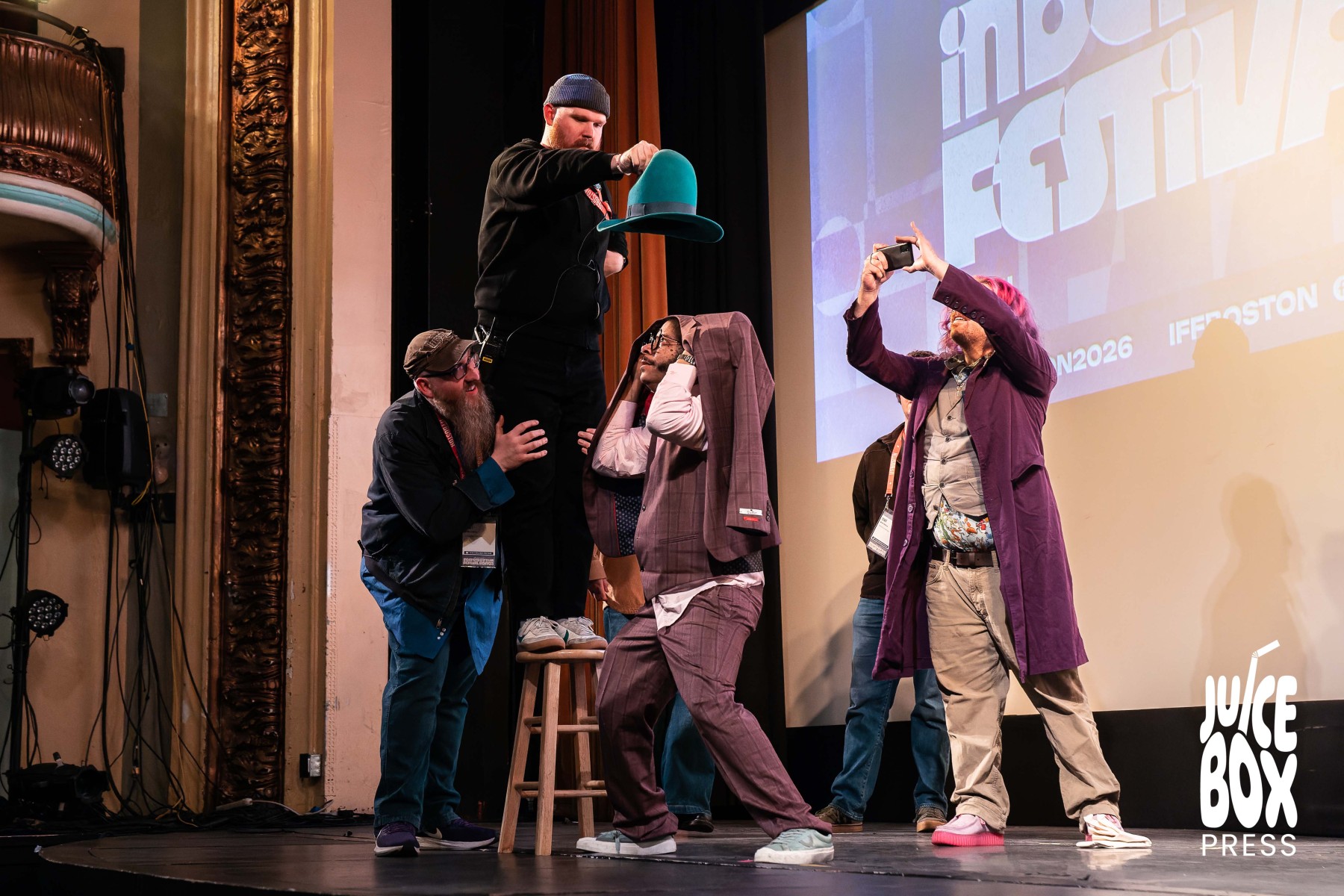
Boots Riley was hard to miss when he took the stage on opening night at IFFBoston. Thick-rimmed square glasses, a towering turquoise felt hat, and dramatic mutton chops gave him the kind of larger-than-life presence that felt perfectly in step with his latest film, I Love Boosters, released via Neon. The film and the conversation that followed made it clear that fashion was not the only way Riley makes a statement.
Borrowing its name from one of Riley’s songs, the film stars Keke Palmer as Corvette, a business-savvy bandit who steals designer clothing with the help of The Velvet Gang (Naomi Ackie as Sade and Taylour Paige as Mariah) before flipping the pieces on the black market in what Mariah cleverly dubs “Triple F: Fashion Forward Philanthropy.” When Corvette isn’t orchestrating five-finger acquisitions, she dreams of becoming a fashion designer like Christie Smith, played by Demi Moore. But when she finally gets the chance to meet her idol, Corvette quickly realizes the warning “never meet your heroes” exists for a reason.
Determined to get even, the group infiltrates one of Smith’s Metro Designer storefronts as employees. But when someone begins outdoing their own boosting operation, Corvette and The Velvet Gang are forced to confront who the real thieves are: the boosters or the corporations. Vibrant, thought-provoking, and inventive, the film feels refreshingly original, blending social commentary with chaotic and fun style.
“In case you couldn’t tell from the film, I’m a communist,” Riley told the crowd during a post-screening Q&A. Growing up in California alongside the rise of Silicon Valley and joining what he described as a “discipline party” at just 14 years old, Riley explained that political organizing and labor movements have long shaped the way he views the world. Though he no longer associates with that group, he said those experiences still influence “how [he] put the puzzle pieces together” for the film.
“We need a world in which the people democratically control the wealth that we create with our labor,” Riley explained. “What we need is a mass, militant, radical labor movement that uses the withholding of labor as a strategy… to challenge the power base of the fascists and capitalists that are out there and demand the things that we want. And I think it’s starting to happen.”
In the film, Riley channels those ideas through the lens of the fashion industry, drawing attention to the disconnect between luxury brands and the overseas sweatshops that manufacture their products. For him, fashion, something so deeply tied to identity and self-expression became “a good way to talk about what we see in front of us versus what it really is, how it got here.” As Riley put it, “A thing is not just a thing. And it’s not just made of things. It’s made of people’s time.” The film visualizes that concept through a device capable of deconstructing objects back into their raw materials, a surreal invention Riley uses to both underline the film’s themes and create some of its funniest moments.
I Love Boosters isn’t Riley’s first film about anti-capitalist theory. In 2018, he released Sorry to Bother You, a film commentary on corporate greed. “As far as I know, Sorry to Bother You is the most effective piece of culture I’ve ever made,” Riley said, sharing stories of how the film “radicalized” audiences.
He pointed to the period between 2020 and 2024, when we “saw the largest strike wave in the US since the 70s.” During that wave, Riley said he received dozens of messages from fans who weren’t sure they could convince their co-workers to strike or unionize until watching Sorry to Bother You. He recalled one fan telling him they quoted the film, shouting, “Equisapiens, let’s be out!” before their entire company raised their hands and voted to strike.
I Love Boosters positions itself as a similar mobilizing force. After The Velvet Gang learns about the conditions inside the factories from an escaped and exploited worker, they join forces to fight back. Through that alliance, Riley reinforces the idea that collective action often begins with a single person willing to speak up, and that there is power in numbers.
Riley amplifies these ideas through the nostalgic visual language of his films. Though singular in their maximalism and eccentricity, from Christie’s askew apartment in I Love Boosters to his saturated color palette, Riley draws heavily from earlier filmmakers and styles, grounding his larger political ideas in familiar visual references that make them feel accessible rather than abstract.
In Sorry to Bother You, Riley described “sampling” a shot from Mishima: A Life in Four Chapters, borrowing its dramatic camera push-in for the golden elevator scene. For I Love Boosters, Riley said the score was heavily inspired by Black Cat, White Cat by Emir Kusturica.
“I was listening to that score the whole time I was writing this,” Riley said. “Then I brought in Tune-Yards before I finished writing and showed them what I was listening to. And that’s what started this score off.”
One of the film’s visual inflection points arrives with the introduction of the Skinless people, meant to symbolize the loss of identity that comes with selling your soul to corporate greed. What could have easily felt disturbing or overly grotesque instead becomes strangely approachable through Tim Burton-esque stop-motion animation.
Other influences that he pointed to were Spike Lee, Looney Tunes, Charlie Chaplin, and Jerry Lewis as Cinderfella.
As the Q&A wrapped up, Riley’s final answer made it clear that I Love Boosters is not just a movie, but an extension of the worldview that shaped it. When asked whether he had ever considered going fully independent and making a low-budget film, Riley acknowledged that his projects require large-scale resources, from elaborate sets to animation. More importantly, though, he said he wants to ensure the people working on his films are compensated fairly.
“If I’m gonna have a movie, then I’m gonna convince, let’s say, 30 people to work on something for four months,” Riley said. “They gotta get paid, you know?”
For a film that is as absurd as it is thought-provoking, I Love Boosters proves that Riley remains one of the few filmmakers capable of turning anti-capitalist theory into something genuinely entertaining.
Featured Photo Credit: Neon

Amelia Cordischi, Founder and Editor-in-Chief of Juice Box Press, is an accomplished digital marketing professional with over a decade of experience in media and communications. Her work has been featured in notable publications, including The Boston Globe. A communications graduate of Simmons University in Boston, Amelia served as manager of Simmons College Radio (“The Shark”), where she also launched and co-hosted her radio show, The Find.
In addition to her editorial work, Amelia is an established freelance photographer, with bylines in Blended Magazine and CelebMix, capturing artists and cultural moments across the music and media landscape. Her career began at WCVB-TV’s Chronicle, the ABC affiliate in Boston, where she gained firsthand experience in broadcast journalism and storytelling.
When she’s not taking photos from the photo pit, interviewing emerging artists, or crafting the next Juice Box Press feature, Amelia can be found thrifting and exploring the world of sustainable fashion.